
Is Outdoor Cannabis Lower Quality?
A Licensed Producer Explains
By Tyler Rumi, Co-Founder & Cultivation Lead, GOOD BUDS
Outdoor cannabis is not inherently lower quality than indoor. The real trade-off is cosmetic — bud density and visual uniformity — not potency or terpene expression.
GOOD BUDS Gluerangutan, grown outdoors in FVOPA Certified Organic living soil on Salt Spring Island, BC, tests between 28.7% and 30.9% THC with total terpenes of 3.6–4.8% across COA-verified lots. Most commercial cannabis flower in Canada sits at 1–2% total terpenes.
That doesn't match the reputation outdoor cannabis carries in this country. The gap between perception and data is worth understanding.
The reputation came from somewhere real. Most outdoor cannabis that Canadians remember from before legalisation was grown from unselected genetics with minimal attention — plants left to do their own thing, and the results showed it. That's not what outdoor cultivation looks like when the strain is selected for outdoor expression and the producer actually tends the crop.
We became Canada's first licensed outdoor cannabis cultivation facility in 2019. When we ran indoor trials with the same Gluerangutan genetics, the terpene levels dropped. Yield dropped. THC dropped. For this strain, the outdoor environment isn't the compromise — it's the reason the numbers are what they are. It's grown outside, under the sun, in living soil.
What follows is an honest account of what it actually takes to grow outdoor cannabis well, and why most producers don't bother.
Where the "Outdoor Means Lower Quality" Reputation Came From
The stigma has a real origin. It just isn't about sunlight.
Before legalisation, outdoor cannabis at any meaningful volume was a risk that shaped everything about the product. You couldn't tend plants openly. The smell alone would give you away. So most outdoor cannabis on the market wasn't being grown with much care — it was bush-grown, seeds dropped in a clearing somewhere out of sight, harvested once, and largely left alone in between. No soil management, no phenotype selection, no real attention to the result. That's the outdoor weed that built the reputation.
Indoor was different. You could conceal it, control it, and actually tend to your plants. The craft knowledge in the pre-legalisation market mostly developed indoors, for obvious reasons.
The first producers to get licensed when legalisation became commercial came from that indoor culture. Most early LPs operated under the ACMPR — the regulatory framework that preceded the Cannabis Act — which compliance requirements centred on controlled, indoor production. The genetics circulating in the legal market were indoor-selected, sourced from legal seed banks (largely Amsterdam-based) and traded between producers who were all operating indoors. The commercial logic reinforced it: indoor lets you harvest multiple times a year; outdoor gives you one window, and a bad season can cost you the whole crop.
When the Cannabis Act came into effect in October 2018, outdoor commercial cultivation became a viable, navigable option for the first time. We became Canada's first licensed outdoor cannabis cultivation facility in 2019. Not because no one else wanted to do it; simply because until the regulations changed, no one had built the path to do it commercially at scale.
The outdoor cannabis that earned a bad reputation was grown by people who couldn't tend their plants, using seeds never selected for outdoor expression. That's not what outdoor cannabis is. It's what illicit outdoor cannabis had to be.
What the Sun Actually Gives a Plant That Indoor Lighting Can't
Sunlight isn't just brightness. It's a full spectrum of wavelengths — including UV — that even the best artificial grow lights can only approximate. Plants respond to that spectrum across their full life cycle, and there's research suggesting UV exposure can influence how cannabis expresses its terpene and cannabinoid profile. Outdoor plants also flower on their own schedule, following the natural shift in daylight as the season progresses, rather than a light timer set in a grow room.
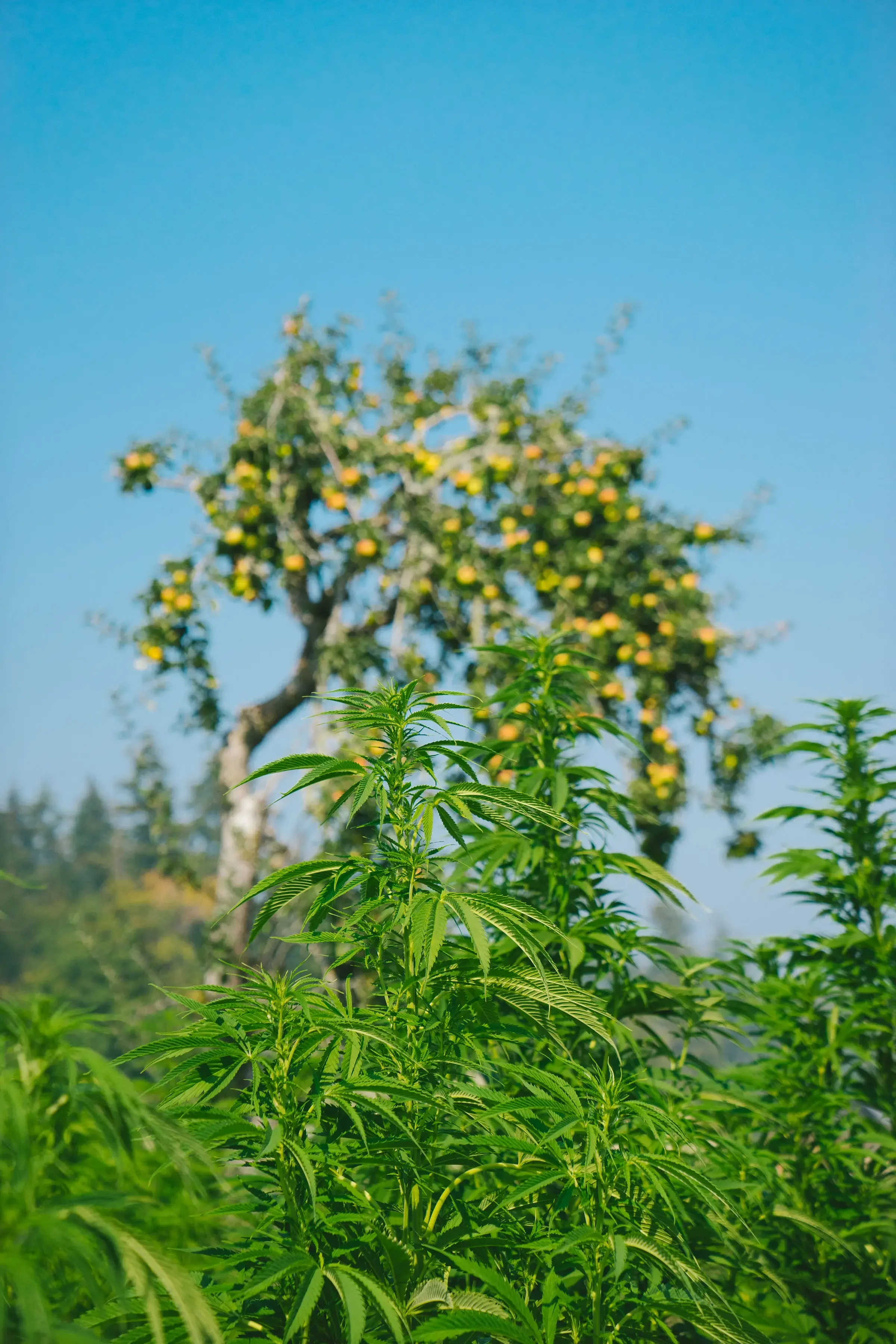
The temperature swings matter too.
On Salt Spring Island, summer days are warm, and nights cool down significantly throughout the season. Plants respond to that drop — it's a signal that the season is changing, and resin production is part of that response. Indoor growers put a lot of effort and energy into replicating that. Outside, it just happens.
The island's position in the Salish Sea matters in the same way geography matters for wine. Salt Spring has long summer days, a temperate Pacific coastal climate, consistent marine airflow, and enough seasonal variation to give plants real growing conditions. We call it ocean-grown because it literally is — cannabis grown surrounded by Pacific coastal air, on island soil with its own biological character.
Geography ends up in the plant. That's it.
The Variable That Matters Most: Genetics and Phenotype Selection
The real issue with outdoor-grown cannabis quality isn't sunlight. It's genetics.
Take a strain bred and stabilised for indoor environments and put it outside, and you'll likely get worse results than you would indoors. Looser buds, less resin, inconsistent expression. That's not outdoor cannabis failing. That's the wrong strain in the wrong environment.
What most producers don't do, because it's expensive and slow, is select specifically for outdoor expression. We did. In 2019, we planted and evaluated approximately 150,000 seedlings to find the phenotype that became Gluerangutan. The selection criteria included not just aroma and terpene profile, but how the plant responded to Salt Spring Island's specific outdoor conditions: how it structured its buds, how it produced resin, how it held up through the season. Three more backcross seasons followed to stabilise what we'd found.
The result is a cultivar that doesn't just tolerate outdoor growing. It actually performs better outdoors than it does indoors, which is the opposite of what's true for most strains.
We learned that the hard way. When we ran the indoor trial of Gluerangutan, it didn't yield as well. It wasn't as sticky. The terpene percentages were lower. THC was lower. We ran the trial to figure out whether to produce it both ways. The data told us no. Gluerangutan belongs outside.
That's strain-specific. Most cultivars produce denser, stickier flower indoors, where you can control every variable. Gluerangutan does the opposite. The temperature drop from afternoon to night, the full-spectrum light, the living soil biology — together they produce something a controlled environment doesn't. It's not a rule that applies to all cannabis. But it's exactly why phenotype selection for outdoor expression matters, and exactly why most producers skip it.
Our Outdoor Harvest Process
We harvest in two passes.
We do the first pass by hand. We go through each plant and cherry-pick the top colas — the biggest, most developed buds — by visual inspection. Those get cut and hung whole on the stem to dry. Whole-plant hang drying lets moisture leave slowly and naturally, which matters for how the flower finishes.
Once dry, we hand-buck — stripping bud and trim leaf off the dried stems. That material then runs through a dry machine trim to separate the trim from the flower. We run the trimmer slowly, with people working alongside it rather than feeding it through at volume. It's not industrial-scale. The throughput is slower; the flower comes out better for it. After trimming, everything is hand-packed.
The second pass goes back to the plant for the smaller, lower buds that didn't make the first cut. Those are wet-trimmed and immediately fresh-frozen for vape and live rosin inputs. Nothing wasted. Each part of the plant goes through the process that suits it.
Not Every Strain Belongs Outside: How We Make the Decision
The honest answer isn't that the outdoors is always better. It's that the right strain belongs in the right environment, and we've made each call based on actual cultivation data rather than preference.
Gluerangutan grows exclusively outdoors. It outperforms its indoor results on every measurable dimension — yield, resin, terpenes, THC. The outdoor environment suits the genetics. That's rare, and it's why we committed to it.
Mango Cake grows indoors for flower. Outside, the buds are too loosely packed, and the flower yield isn't there once trimmed. The plant still grows well outdoors, so that material goes straight to fresh-freeze for vape and concentrate—different plant, different process.
Timewarp grows well both ways. Bud density outdoors is slightly lower than indoors, but it performs well on Salt Spring Island. We grow it outside because it makes sense for the strain and the farm's overall production mix.
The Energy Footprint of Indoor vs Outdoor Cannabis
Indoor cannabis production is energy-intensive. High-intensity grow lights, HVAC, dehumidification, and climate control run continuously through a crop cycle. Different studies put the electricity figure in different places, but they're consistently large — indoor cannabis is one of the most power-hungry forms of agriculture in North America.
Outdoor production, grown under the sun, doesn't require any of that. The light source is free. The natural environment regulates temperature and humidity. At GOOD BUDS, we irrigate with rainwater. We use no synthetic inputs — we're FVOPA Certified Organic. Our soil beds have been in continuous use since 2019 rather than being replaced between cycles.
Outdoor, living soil cannabis grown with rainwater and no synthetic inputs has a fundamentally different production footprint than the same volume of flower grown in a climate-controlled indoor facility under artificial light. If you want to know what it took to produce what you're consuming, the growing method matters.
Why Most Licensed Producers Still Don't Grow Outdoors
Even under the Cannabis Act, outdoor flower remains rare in the legal market. Outdoor cultivation has one harvest window per year — one shot, no chance to course-correct mid-cycle if conditions change. The upfront investment in selecting genetics for outdoor expression is significant and slow. And most LPs built their facilities, compliance systems, and supply plans around indoor production, because that's what the industry knew when they were building it.
Growing outdoors was a deliberate choice that required building for it from the start. We did. Most didn't. That's a business decision, not a quality statement.
What Gluerangutan's COA Data Actually Shows
Gluerangutan's tested lots show total terpene levels ranging from 3.6 to 4.8%, with a caryophyllene-dominant profile, co-primary humulene, and secondary limonene and linalool. That total terpene load is the highest in our portfolio and sits at the high end of what shows up across the Canadian legal market.
THC ranges from 28.1% to 31.9%, with lots harvested at peak maturity reaching 31–32%.
Those are numbers you'd expect from a well-grown indoor craft strain — except they're coming from a plant grown outside, under the sun, in living soil on Salt Spring Island. That's the whole point of the post. The environment isn't a compromise. For the right strain, it's the reason the numbers are what they are.
FAQs About Outdoor Cannabis
Is outdoor cannabis lower-potency than indoor?
Not necessarily. Potency depends on genetics and cultivation, not the growing environment. Gluerangutan tests at 28–32% THC grown outdoors in living soil — competitive with any indoor production. The idea that outdoor automatically means lower THC is a generalisation that breaks down once the right strain is matched to the right outdoor environment.
Does sun-grown cannabis have more terpenes than indoor?
It depends on the strain. Some cultivars fully express their terpene profile outdoors; others do better under controlled indoor conditions. Gluerangutan is the first kind — its outdoor terpene profile exceeds what we measured indoors. Mango Cake is the second — its indoor flower consistently produces its characteristic terpene profile, and its outdoor expression doesn't replicate that.
What does FVOPA Certified Organic mean for cannabis?
FVOPA — the Fraser Valley Organic Producers Association — is a BC-based organic certification body. The certification covers farming inputs and practices: no synthetic pesticides or fertilisers, plus soil management standards. For cannabis, it means the farm has been audited against organic standards by an independent certifier. GOOD BUDS is FVOPA Certified Organic at the farm level.
Why do outdoor cannabis buds sometimes look different from indoor ones?
Bud density and structure vary by strain and growing method. As a general rule, indoor plants grown under optimised light and controlled humidity tend to produce denser, more compact flower. Outdoor plants exposed to natural conditions can produce buds with a different structure. Gluerangutan is the exception that proves the rule — it produces denser, stickier buds outdoors than it does indoors, which is part of what makes it an unusually strong outdoor cultivar.
Is sun-grown cannabis more environmentally responsible?
Outdoor cannabis grown under natural light has a significantly lower energy footprint than indoor production. At GOOD BUDS, outdoor production also uses rainwater irrigation, no synthetic inputs, and living soil beds maintained across multiple seasons rather than replaced. Whether that adds up to "more environmentally responsible" overall depends on factors beyond the grow method, but the energy comparison alone is significant and well-documented.
What's the difference between outdoor, greenhouse, and indoor cannabis?
Indoor cannabis is grown entirely under artificial light in a climate-controlled environment. Greenhouse cannabis is grown in a structure that uses natural light but provides environmental protection and some climate control. Outdoor cannabis is grown directly in the field under full natural sunlight with no enclosure. Each method involves trade-offs in control, cost, energy use, and seasonal availability. Outdoor is the only one of the three that reflects genuine terroir — the influence of a specific place and climate on the plant.
Gluerangutan is available in flower, pre-roll, and vape formats in BC, Alberta, and Ontario. Grown on Salt Spring Island. FVOPA Certified Organic.
Tyler Rumi is co-founder and cultivation lead at GOOD BUDS, Canada's first licensed outdoor cannabis producer. He has grown cannabis in living soil on Salt Spring Island, BC, since 2017.