
Gluerangutan: A Sun-Grown Organic Cannabis Strain from Salt Spring Island, BC
Selected from 150,000 plants on Salt Spring Island.
By Tyler Rumi, Co-Founder and Cultivation Lead, GOOD BUDS. Published 14 April 2026. Updated 17 September 2026
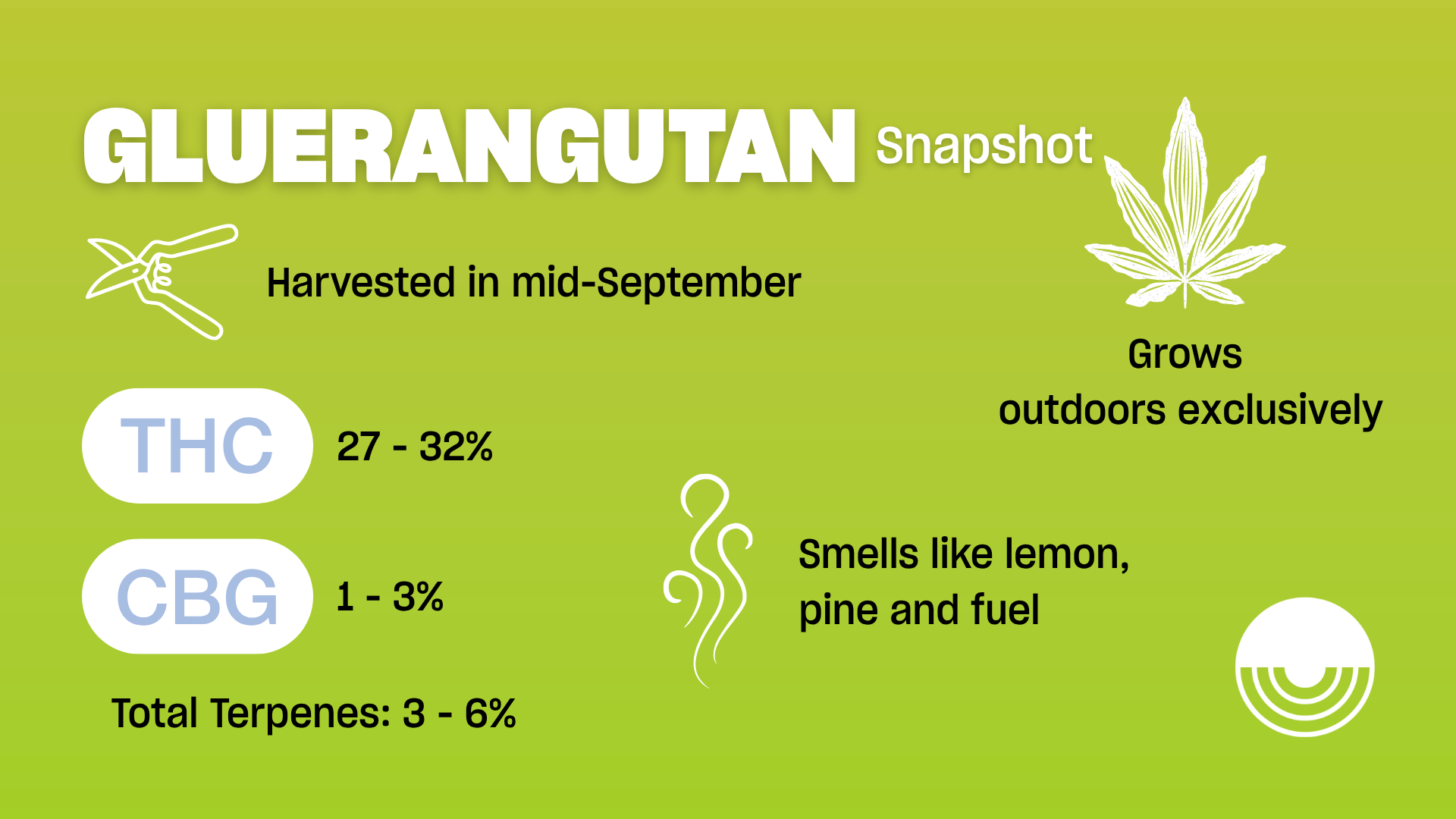
Gluerangutan is a house-bred, sun-grown cannabis strain from GOOD BUDS, a family-run, FVOPA Certified Organic farm on Salt Spring Island, BC, founded in 2017 by brothers Tyler and Alex Rumi and Canada's first licensed outdoor cannabis cultivator. We bred it from the Harambe variety (OG Kush x GG4 x Afghani Hash Plant), pheno-hunted it from 150,000 plants in 2019 and stabilised the cut over three sun-grown seasons. It grows in living soil, watered with rainwater, and is harvested once a year in mid-September. COA-verified total terpenes run 3.6 to 4.8%, the highest in our portfolio, with a spicy, piney, citrus profile. Gluerangutan is sold as flower, pre-rolls and vapes at licensed retailers in BC, Alberta and Ontario.
What Is Gluerangutan?
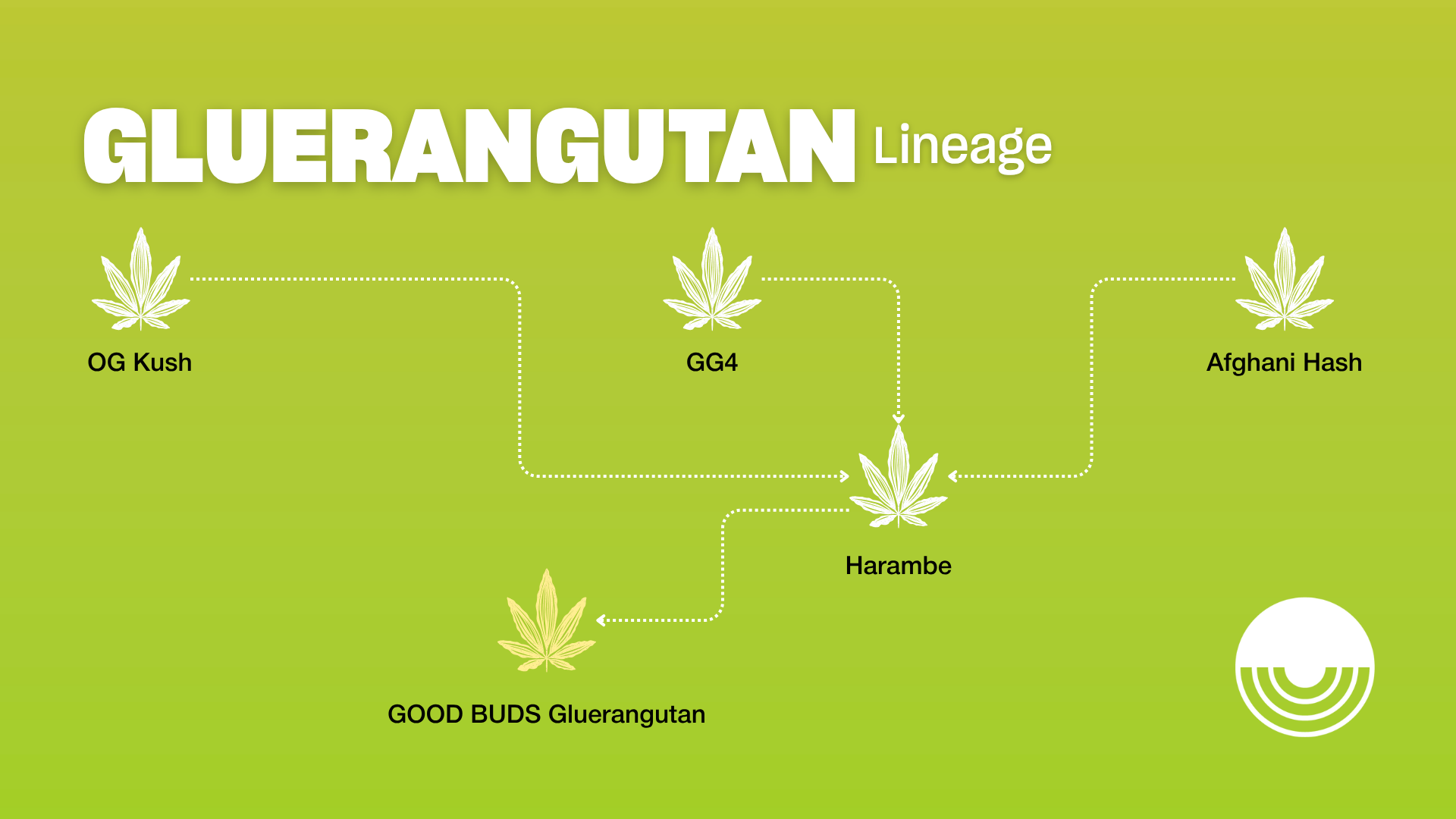
Three parents: OG Kush, GG4 and Afghani Hash Plant. The Harambe variety crosses all three, and we spent three seasons backcrossing it until we landed on the cut we grow today: the most resinous, spice-forward expression we could pull out of that gene pool.
It leans Indica in structure. Low, compact, dense. The terpene profile and the resin load pull from all three parents, so it does not sit neatly in one lane. It is a hybrid in the plain sense of the word.
The Name
Gluerangutan is a play on Gorilla Glue (GG4's original name, and a direct parent) and orangutan, a nod to the gorilla in the Harambe name. Harambe comes from the Swahili word harambee, meaning "pull together". We had glue in the genetics and a primate in the lineage story, and orangutan was the right lateral move. It is a tongue twister. That is part of the point.
How GOOD BUDS Grows Gluerangutan
Our beds are on Salt Spring Island: living soil, watered with rainwater collected off our roofs. We have farmed these beds since 2019, our first licensed sun-grown season. The farm is FVOPA Certified Organic and Buy BC approved.
The plants stay low. Waist-height in a good year, sometimes less. What they give up in height they put back into density — compact, close-branching, all bud and almost no stem. That's the OG Kush architecture showing up. Then there's the resin, which is the Hash Plant side of the family. Walk the rows in early September and your hands are sticky by the second plant.
We harvest by hand in mid-September, hang-dry the plants whole, then hand-buck the dried buds off the stems before they go through the machine trimmer. The sequence matters — keeping the buds on the stem through the dry preserves structure and aroma in ways that processing fresh doesn't.
Our outdoor harvest sequence:
Gluerangutan: mid-September
Timewarp: late September to early October
Mango Cake: mid- to late October (outdoor plants go to extract inputs only)
Gluerangutan finishes first, on its own schedule.
Why Gluerangutan Works Sun-Grown When Most Strains Do Not
Indoor cannabis has real advantages. Under lights you control temperature, humidity, light hours and feeding, and that control shows up in the flower: tighter bud structure, bigger buds, higher THC and more yield per plant. Most modern strains were bred for those rooms. Breeding programmes for the last thirty years have selected almost entirely for flavour, potency and bud structure, not for surviving weather. Put most of them outside on the BC coast and they struggle with powdery mildew, botrytis, pest pressure, or a flowering window that runs past the first fall rains. Some do not finish. Some just die.
Growing good sun-grown cannabis is harder than growing good indoor cannabis for exactly that reason. You cannot dial in the variables, so the genetics have to do more of the work. Most sun-grown flower gives something up: THC a few points lower, looser structure, a little larf where the canopy is open. That is the normal trade, and for the right strains the sun and the soil pay it back in terpenes.
Gluerangutan is the exception on our farm. We ran it indoors for a while, and the indoor version was fine. Outside on Salt Spring it hits nearly every mark we would want from an indoor plant: dense, tight buds, heavy resin, total THC around 30% and the highest terpene load we grow. Not quite what top-end indoor achieves, but closer than any sun-grown strain we have worked with, and better than our own indoor runs of the same cut. Our best guess is that the OG Kush and Afghani side of the genetics responds to something specific here: cold September nights, full-spectrum light, the stress cycling of a real season. We are guessing. What we know is that every number we can test came back higher from the field than from our rooms.
The trade-off is yield. Gluerangutan stays low and compact and does not put on the size that Timewarp or a sun-grown Mango Cake plant will, so we harvest less weight per plant. Every other mark is good enough that we grow it anyway.
So it lives outside now.
The Pheno Hunt: 150,000 Seedlings, Three Seasons
2019, first outdoor season. 150,000 plants in the ground. One of the blocks was Harambe: the OG Kush × GG4 × Afghani Hash Plant cross we wanted to work with.
The job was to walk the rows and find the individuals that did what we wanted: dense structure, resin load, the right terpene character, right harvest timing. Mark them, cross them, plant them again. Year two, narrow it further. Year three, the cut stabilised.
We were after three things specifically: the spicy-woody kush terpene character from GG4 and OG, the resin yield the Afghani brings, and a structure that could carry both of them through an outdoor season without falling apart. The cut we grow now does that reliably, which is not a given for a strain carrying this much resin.
Lineage: What Three Parents Contribute
Gluerangutan's character makes more sense when you understand what each parent contributed.
OG Kush
OG Kush showed up in Florida in the early 1990s and made its way to California by 1996, when Matt "Bubba" Berger and Josh D brought a surviving cutting to Los Angeles. The genetics are legitimately disputed — the most accepted version points to a Chemdawg × Lemon Thai × Hindu Kush cross. What isn't disputed is what it became: the genetic backbone of West Coast cannabis, parent to GSC, Bubba Kush, Headband, and — through the Harambe cross — to Gluerangutan.
OG Kush contributes compact bud architecture, an earthy-spicy-citrus terpene foundation, and 30 years of proven potency genetics. The limonene in Gluerangutan's COA data traces back through here. So does the fenchol — that piney, herbal note in the back of the profile.
OG Kush is typically myrcene-dominant, with caryophyllene secondary. In Gluerangutan's COA data, myrcene is absent or negligible across all tested lots, and caryophyllene has moved to the front. The GG4 and Afghani side of the Harambe cross appear to have driven that shift — amplifying the spicy-woody character while the limonene and fenchol layers carried through from the OG side.
GG4
GG4 was created by accident between 2009 and 2011 by Nevada breeder Josey Whales, when a Chem's Sister plant turned hermaphrodite and pollinated a Sour Dubb crop. His friend Mardogg grew out the seeds; phenotype number 4 was selected for its resin and terpene expression. The name came from the plant itself: trimming scissors would fuse shut from the resin.
GG4 won multiple Cannabis Cups in 2014 and 2015, then a 2017 trademark settlement with the Gorilla Glue adhesives company forced a rebrand to GG4 or Original Glue at an estimated cost of $250,000.
For Gluerangutan, GG4 contributes the caryophyllene backbone that anchors the whole terpene profile, the extreme resin density, and the outdoor structural vigour. The trans-caryophyllene numbers we see across dozens of lots hits around 0.9-1.3%. This comes from GG4's genetic inheritance. Like the GG4 parent, Gluerangutan will jam your grinder to a halt, glue your scissors shut, and stick to your fingers when you try to roll it.
Afghani Hash Plant
The Afghani/Hash Plant in Gluerangutan's lineage traces to the Hindu Kush mountains, where farmers selected plants for maximum resin production over centuries. Seeds reached North American breeders through the Hippie Trail in the 1960s and 70s.
The Pacific Northwest Hashplant clone, a direct precursor to the Sensi Seeds commercial Hash Plant strain, was grown on BC's Sunshine Coast for decades before entering formal breeding. There's a line running from the Afghan mountains to BC's coast to the resin load on Gluerangutan's buds every September.
What this parent contributes is extreme trichome density, compact bud structure, high calyx-to-leaf ratio, and the resin yield that makes Gluerangutan perform at the top end of solventless extraction.
A note on terpene inheritance: each of the three parents shares caryophyllene as a consistent compound. GG4 most strongly, but OG Kush and Afghani both carry it. Their synthesis pushed caryophyllene to the dominant position and reduced the myrcene that OG Kush typically carries. The citrus-pine layer came through from the OG Kush side.
Terpene Profile: Spice, Pine, Citrus
Shorthand for the profile is spice, pine and citrus.
Break a bud up and the first thing you get is the spice. That is trans-caryophyllene doing the heavy lifting: peppery, woody, resinous, and consistently over 1%, the single most dominant compound in anything we grow. Alpha-humulene rides alongside it at about half a percent and adds the earthy, hoppy depth underneath. Together they are the base note. Heavy, resinous, old-school kush.
Limonene is the citrus: 0.5 to 1%, and the most variable compound in the profile. When it runs high, the citrus hits you first. When it runs lower, the spicy-woody side comes forward and the citrus sits behind it. Either way it is there.
Fenchol is where the pine comes from: 0.19 to 0.26%, fresh and herbal, present in every lot, usually on the exhale. Linalool sits underneath all of it at 0.16 to 0.35%, a soft floral note that rounds the profile off without announcing itself.
Total terpenes typically land at 3.6 to 4.8% depending on the lot, the highest of any strain we grow.
Total THC across confirmed lots runs 28.1 to 31.9%, with most lots landing around 30%. Well-developed lots hit 31 to 32%. Not the highest in our portfolio, Mango Cake takes that title, but consistent from lot to lot.
Gluerangutan vs Timewarp vs Mango Cake
All three strains are grown on Salt Spring Island in FVOPA Certified Organic living soil. They grow differently and express differently.
Gluerangutan is compact, low-growing and harvested first, in mid-September. Timewarp is taller, more open in structure and fruit-forward rather than spice-forward, harvested late September to early October. Mango Cake performs best indoors; our sun-grown Mango Cake plants go to vape and concentrate inputs only.
Timewarp carries the looser, more open structure that is typical of sun-grown flower. Gluerangutan is the exception: tight, resinous, close-packed nugs on a sun-grown plant.
| Attribute | Mango Cake | Gluerangutan | Timewarp |
|---|---|---|---|
| Grow environment | Indoor (flower) / sun-grown (extract) | Sun-grown | Sun-grown |
| THC | 28–32% | 27–32% | 27–31% |
| Total CBG | 2–3.5% | 0.5–1.5% | 0.5–2% |
| Total terpenes | 3–4.5% | 3.5–5% | 2.5–3.5% |
| Dominant terpene | Terpinolene | Trans-caryophyllene | Myrcene |
| Aroma | Mango, cakey, vanilla | Spice, wood, citrus | Cherry, orange rind, floral |
| Harvest window | Year-round (indoor) / mid–late Oct (extract) | Mid-September | Late Sept–early Oct |
Who Gluerangutan Is For
Gluerangutan is not for everyone.
If you gravitate toward OG Kush, Pink Kush, GG4 and the rest of that spicy-woody, resin-heavy family, if that is where your eye lands when you read a menu, Gluerangutan is built for you. Same lane, sun-grown in living soil, pheno-selected to be the most concentrated version of itself we could produce.
It is also for anyone curious about what a sun-grown, living soil expression of a resin-dense hybrid looks like. Most growers assume a strain like this would lose density outside. Gluerangutan does the opposite.
If you lean toward hash, rosin or live resin formats, the Afghani genetics matter. That parent was selected for resin production over generations, and it is why Gluerangutan yields the way it does for extraction.
And if OG and GG4 are where you have always landed, because that spicy, resin-forward profile is simply the thing you like, Gluerangutan is a direct line back to those roots. Sun-grown. Living soil. Three seasons of selection. Same gene pool, our expression.
If You Know These Strains, You Will Know Where Gluerangutan Sits
OG Kush: The foundational parent. Gluerangutan shares OG's spicy-woody-citrus terpene architecture but is caryophyllene-dominant, where OG Kush typically leads with myrcene. The density and structure are familiar; the terpene emphasis has shifted.
Pink Kush: A widely stocked OG-family strain in Canada, caryophyllene-prominent, dense, resin-forward. The terpene structure is similar, with Gluerangutan adding GG4 resin density and the Afghani Hash Plant trichome load on top.
GG4: A direct parent. Gluerangutan carries GG4's caryophyllene backbone and resin density into an outdoor living soil environment, with a more complex terpene stack from the OG Kush and Afghani parents layered on top.
Ghost OG: The OG Kush phenotype closest to Gluerangutan's profile, both caryophyllene-dominant with limonene secondary and humulene present. Not widely available in Canada, but useful as a reference for anyone navigating the OG family.
Available Formats
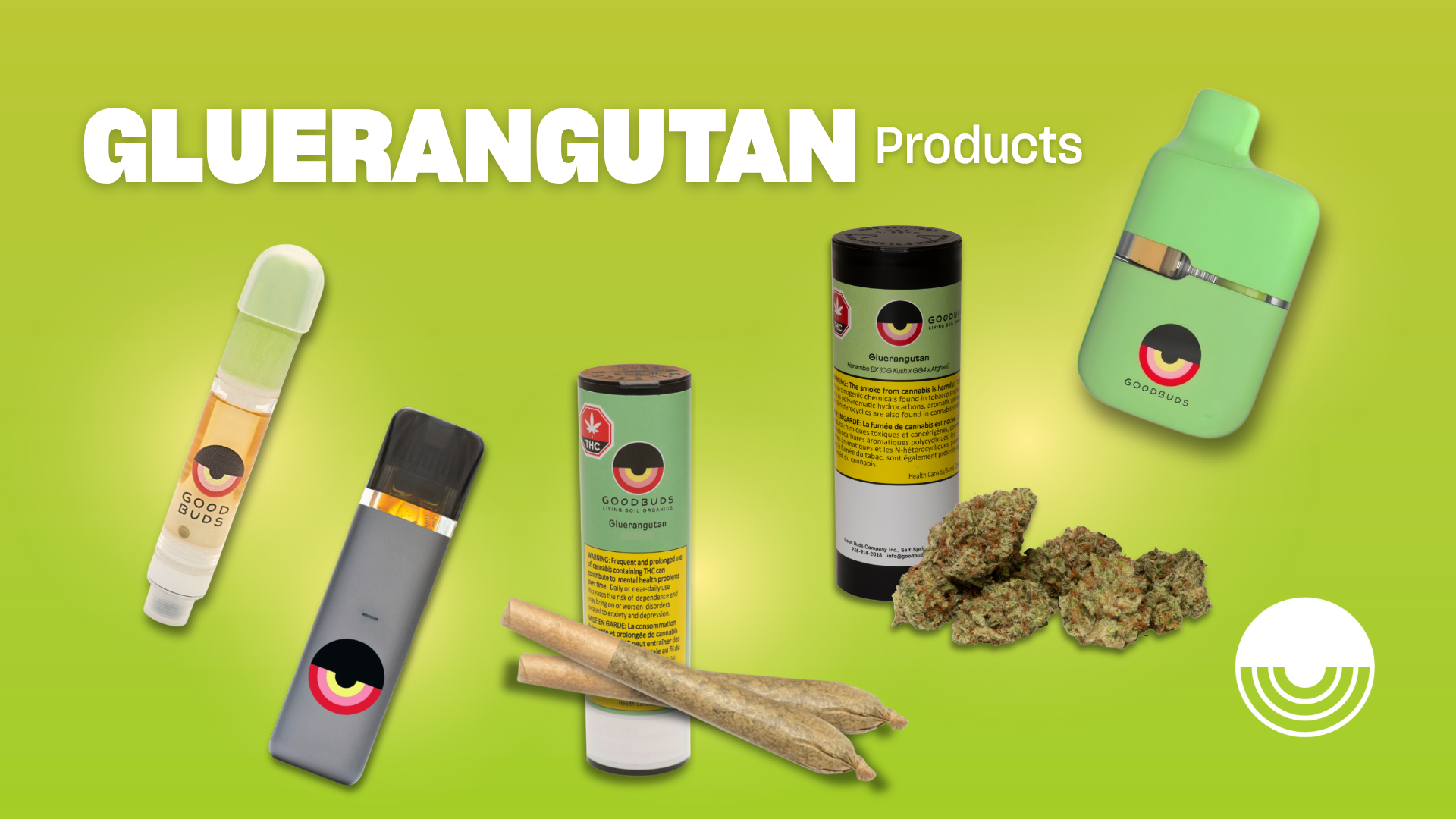
Gluerangutan 7g Flower: BC, Alberta and Ontario
Gluerangutan 1x1g Pre-Roll: BC and Alberta
Gluerangutan 7×0.5g Pre-Rolls: BC, Alberta and Ontario
Gluerangutan 1g Cured Resin AIO Vape: BC, Alberta and Ontario.
Gluerangutan 1g Live Resin 510 Vape Cartridge: BC and Alberta.
Gluerangutan 0.5g Live Rosin AIO Vape: BC only.
All Gluerangutan flower, pre-rolls and vape products start with the same sun-grown harvest: grown in living soil on Salt Spring Island, FVOPA Certified Organic, picked once a year in mid-September.
Related Reading
Timewarp: our sun-grown BC heirloom strain
Mango Cake: our indoor strain and how it differs
What living soil is and what is in our beds
FAQs
-
Gluerangutan is a sun-grown hybrid cannabis strain bred by GOOD BUDS from the Harambe variety, a cross of OG Kush, GG4 and Afghani Hash Plant. It is grown in living soil on Salt Spring Island, BC, is FVOPA Certified Organic and is harvested in mid-September. It is sold as flower, pre-rolls and vapes at licensed retailers in BC, Alberta and Ontario.
-
Spice, pine and citrus. Trans-caryophyllene and alpha-humulene give it a spicy, peppery, woody base. Some describe it as fuel-like. Limonene adds citrus brightness and varies from lot to lot, which is why the citrus note shifts between batches. Fenchol adds the pine. Total terpenes run 3.6 to 4.8% across COA-verified lots.
-
Harambe is a rare cannabis variety that crosses OG Kush, GG4 and Afghani Hash Plant. Several breeders sell strains under the name. The one in the GOOD BUDS lineage was grown from seed in our first sun-grown season in 2019 and pheno-hunted over three seasons to arrive at the Gluerangutan cut now in production.
-
The name is a play on GG4, formerly known as Gorilla Glue and a direct parent, and orangutan, a nod to the gorilla in the Harambe name. It is unusual enough to be memorable and points straight at the genetics.
-
Based on our third-party lab COA tested lots: trans-caryophyllene dominant (0.92 to 1.28%), alpha-humulene co-primary (0.32 to 0.46%), limonene secondary (0.47 to 1.07%), fenchol supporting (0.19 to 0.26%), linalool (0.16 to 0.35%) and trans-nerolidol variable (0 to 0.66%). Total terpenes 3.6 to 4.8%. Total THC 28.1 to 31.9%, typically around 30%. The character is spicy, woody and citrus with pine depth.
-
Sun-grown, on our farm. Indoor cannabis usually wins on bud structure, THC and yield per plant, and most modern strains were bred for indoor rooms, so they struggle with mould, pests and short seasons outside. Gluerangutan is the exception: grown under the sun on Salt Spring Island it produces denser buds, more resin and higher total terpenes than the lots we grew under lights, so we stopped growing it indoors. The one trade-off is a smaller plant and lower yield per plant than Timewarp or Mango Cake.
-
Sun-grown on Salt Spring Island in living soil, irrigated with rainwater. The farm is FVOPA Certified Organic, BC's cannabis-specific organic certification. Plants are hand-harvested, hang-dried whole, hand-bucked and slow-cured once a year. GOOD BUDS has farmed these beds since 2019.
-
Both are sun-grown on Salt Spring Island in living soil. Gluerangutan is compact and low-growing, harvested in mid-September, with a spicy, woody, citrus terpene profile and unusually tight buds for a sun-grown strain. Timewarp is taller and more open in structure, harvested late September to early October, and fruit-forward, with dark cherry and orange citrus notes. Same farm, same soil, two different expressions.
-
Gluerangutan flower, pre-rolls and vapes are sold at licensed cannabis retailers across BC, Alberta and Ontario, supplied through the BCLDB, AGLC and OCS. Nothing is sold on this website. Use the GOOD BUDS store locator to find a retailer near you.
Find GOOD BUDS Gluerangutan Near You
GOOD BUDS is a family-run cannabis farm on Salt Spring Island, BC, founded in 2017 by brothers Tyler and Alex Rumi and FVOPA Certified Organic. Gluerangutan is available at licensed retailers in BC, Alberta and Ontario.
GOOD BUDS is a family-run cannabis farm on Salt Spring Island, BC. Founded in 2017 by brothers Tyler and Alex Rumi. Canada's first licensed outdoor cannabis producer. FVOPA Certified Organic.
About the author
Tyler Rumi is co-founder and cultivation lead at GOOD BUDS. He has bred and grown cannabis in living soil on Salt Spring Island, BC, since 2017.